
- £245K
- Meta ad spend
- 1,875
- First-time depositors
- £130.67
- Blended CPFTD
- £560K+
- Total deposits
Campaign overview
The client approached Advera after several unsuccessful attempts to turn Meta into a reliable acquisition channel.
Previous campaigns had generated clicks and registrations, but performance became unstable the moment budgets increased. Spend would climb for a few days, results would look promising, and then costs would drift upward again with no clear explanation. On top of that, the client had limited visibility into which campaigns, funnels and creatives were actually producing depositing players, rather than just traffic and sign-ups.
Our objective was to build the channel from the ground up, rather than optimise an existing setup that lacked the right foundations:
- Establish stable campaign infrastructure
- Connect Meta with verified registration and deposit data
- Identify creative concepts that attracted depositing players, not just clickers
- Validate the acquisition economics before committing serious budget
- Scale the strongest campaign combinations without losing control of CPFTD
The account began with controlled, deliberately small testing. As conversion data accumulated and the strongest combinations became clearer, spend increased progressively across the second and third months: always following performance, never ahead of it.
The results
Across the initial 90-day campaign period, Advera generated:
- £245,000 in Meta ad spend
- 10,420 player registrations
- 1,875 first-time depositors
- £130.67 blended cost per FTD
- 18% registration-to-FTD rate
- £560,000+ in total deposits
- 43.8% second-deposit rate
- £5,800 peak daily spend
Monthly spend increased from £25,000 in Month 1 to £150,000 in Month 3: a six-fold increase in ninety days.
At the same time, CPFTD moved in the opposite direction: from £200 during the initial testing phase down to £120 once the strongest creatives, funnels and conversion signals had been validated. Spend and efficiency improved together, which is the outcome that matters far more than either number in isolation.
The challenge
The client had a competitive product and sufficient budget behind it, but Meta had not yet developed into a predictable acquisition channel. Four distinct problems were limiting performance, and each needed to be solved before the account could scale responsibly.
Meta was optimising toward registrations
The platform received substantially more registration events than confirmed deposit data. In practice, this meant Meta's algorithm was very good at finding people willing to open an account, but had no real signal to identify the users who were likely to fund one. The optimisation target and the business objective were not the same thing.
Creative performance was judged too early
Previous advertisements were primarily evaluated using CTR, CPC and registration CPA. These metrics are useful for an early read on an ad's appeal, but they say nothing about what happens after the click. A creative could look like a clear winner on the surface while quietly attracting low-value users who never deposited.
Campaign delivery depended on limited infrastructure
The existing setup relied too heavily on a small number of individual advertising assets. When an account experienced a restriction, campaign momentum and, more importantly, data continuity were interrupted, sometimes forcing the client to effectively start over.
Scaling increased acquisition costs
Whenever daily budgets were raised, Meta expanded delivery into weaker audience segments to spend the additional budget. The account could technically spend more, but not while maintaining acceptable player economics: spend and quality moved in opposite directions.
Taken together, the challenge was never simply "launch more advertisements." Advera needed to connect infrastructure, tracking, creative production and campaign optimisation into a single, coherent acquisition system, where every part reinforced the others.
Why the UK?
The cheapest GEO is not automatically the best GEO: a lesson that shapes every market decision Advera makes.
The UK combines relatively high CPMs, strict advertising requirements and intense competition between well-established operators. On paper, that looks like an expensive and difficult market to enter. In practice, it also offers meaningful player value and substantial scaling capacity once the product, payments and acquisition funnel are properly aligned: which is exactly what made it worth pursuing.
Before launching a single ad, we assessed:
- Product localisation
- Payment success rates
- Average first-deposit value
- Registration-to-FTD performance
- Player retention
- Available creative angles
- Acceptable acquisition cost
- Total addressable audience
- Compliance requirements
The client's existing player data showed that UK depositors could support a materially higher CPFTD than players in lower-value markets. That single insight made the GEO commercially attractive despite the more expensive auction: the higher entry cost was more than offset by what each depositor was actually worth.
| Factor | UK assessment |
|---|---|
| Auction cost | High |
| Competition | High |
| Compliance complexity | High |
| Player value | High |
| Scaling capacity | High |
"We select GEOs based on acquisition economics, not cheap traffic."
Building the foundation
Before meaningful spend entered the account, Advera audited the complete acquisition journey, step by step:
- Meta advertisement
- Landing experience
- Player registration
- First-time deposit
- Repeat deposit
- Player value over time
This audit revealed exactly where conversions were being lost along the way, and, just as importantly, which pieces of data needed to be returned to Meta so the algorithm could actually learn from real outcomes instead of surface-level signals.
The initial setup included:
- Meta Pixel implementation
- Conversions API
- Server-side registration events
- Confirmed FTD postbacks
- Campaign and creative identifiers
- Backend reconciliation
- Domain and event verification
- Dedicated testing and scaling campaigns
Critically, the client's core conversion data was kept separate from the individual execution accounts running the actual campaigns. That separation meant campaign delivery could be moved whenever necessary, without ever having to rebuild the entire measurement foundation from scratch.
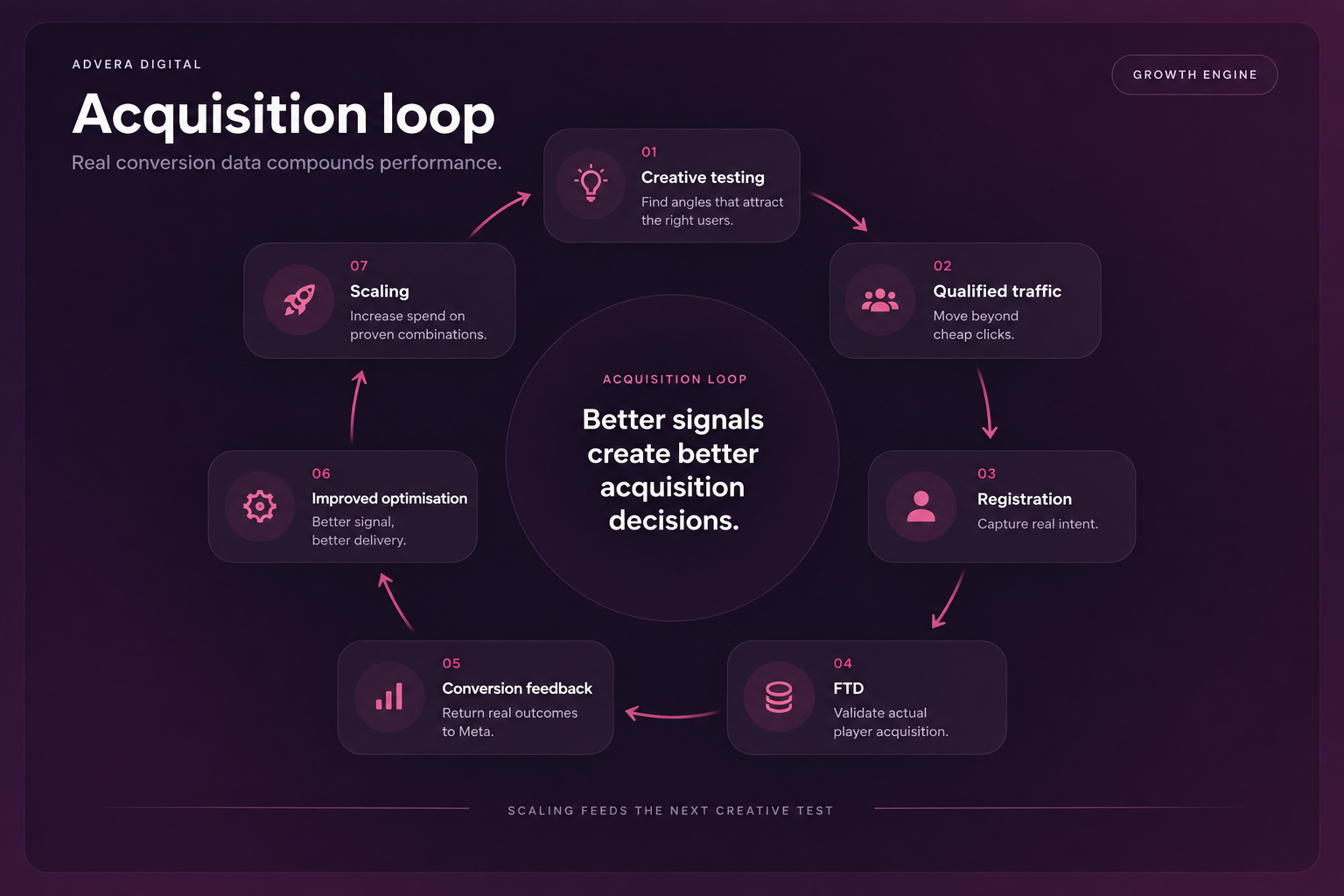
The acquisition system
The campaign was built around four connected components, each one designed to reinforce the others rather than operate in isolation.
1. Optimisation toward confirmed depositors
Meta received verified FTD events through the server-side tracking setup, giving the algorithm a real, trustworthy signal to optimise toward.
Registrations remained useful as a funnel diagnostic: they still told us where users were dropping off, but campaign decisions were ultimately based on the cost and quality of acquired depositors, not on how many people signed up.
2. Separate testing and scaling environments
New advertisements always entered controlled testing campaigns with modest, capped budgets first.
Only concepts that produced acceptable downstream performance, real depositors at an acceptable cost, were promoted into scaling campaigns. This structure prevented unproven creatives from quietly burning through large budgets before their true performance was known.
3. Continuous creative production
New creative concepts and variations entered the account every single week, without exception.
Production continued in parallel while existing winners were being scaled, which meant the account never became dependent on a small handful of advertisements that would eventually fatigue.
4. Redundant campaign execution
The account structure was deliberately designed so that a problem with one execution asset would never automatically remove access to the client's complete conversion history.
When an advertising account did encounter delivery problems during the first month, campaigns were quickly reorganised across the available infrastructure, while the existing dataset kept collecting conversion information uninterrupted in the background.
Creative strategy
The creative strategy combined genuine product relevance with formats that feel native to the Meta platforms, rather than looking like generic paid advertising.
We developed four main creative territories.
Product-led creative
Gameplay footage, recognisable game mechanics and the platform interface gave users an immediate, honest understanding of the product before they ever clicked through.
Entertainment-led creative
Fast-paced videos built around the excitement and entertainment value of the slots experience itself, deliberately avoiding unrealistic financial claims or promises.
Offer-led creative
Bonus and promotional advertisements gave users a clear, concrete reason to register. Offer conditions and required regulatory messaging were built directly into the creative templates from the start, rather than added as an afterthought.
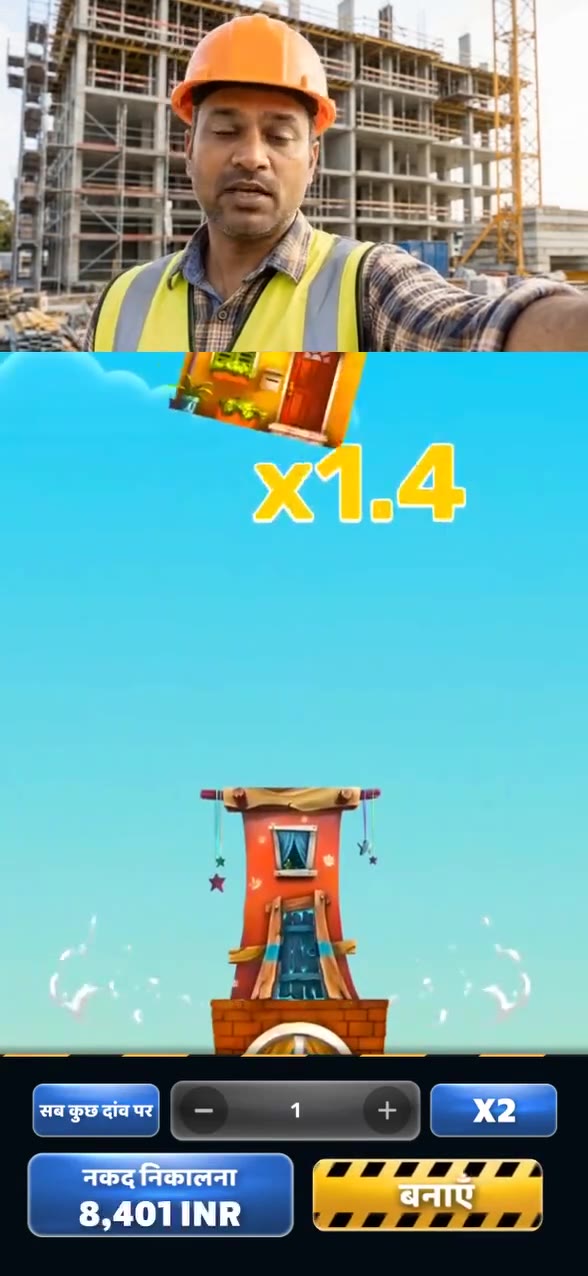
Native and creator-style creative
Lo-fi videos, reactions and creator-led concepts were designed to sit naturally within the Facebook and Instagram feed, blending in rather than standing out as an obvious ad.
Rather than assuming a single format would perform consistently across every audience, each of the four territories was tested across:
- Static images
- Carousels
- Short-form video
- Stories
- Reels
- Feed placements
- Different hooks and opening frames
- Product-led and offer-led messaging



Looking beyond CTR
The creative generating the most clicks was not the creative producing the most valuable players: and this gap turned out to be one of the most important findings of the entire campaign.
| Creative concept | CTR | Registration CPA | Reg2Dep | CPFTD |
|---|---|---|---|---|
| Bonus-led static | 2.51% | £11.20 | 8.4% | £133.33 |
| Gameplay reel | 1.94% | £14.10 | 13.8% | £102.17 |
| Native creator video | 1.71% | £16.40 | 18.1% | £90.61 |
| Branded carousel | 1.43% | £18.30 | 14.6% | £125.34 |
The bonus-led creative generated the cheapest registrations and the highest CTR: by a clear margin, in fact the kind of result that would normally be declared an early winner.
Yet the native creator video produced more than twice the registration-to-deposit rate, resulting in the lowest CPFTD of any concept tested. Judged on clicks alone, it would have been ranked last; judged on depositors, it was the strongest performer in the account.
This became a core scaling principle for the rest of the campaign: creatives were promoted based on depositor economics, never on surface-level engagement metrics alone.
The first 90 days
The campaign developed across three distinct, natural phases: each building directly on the data gathered in the one before it.
Month 1: Building the signal
The first month focused entirely on infrastructure, tracking and testing, with spend kept deliberately controlled.
We launched multiple creative concepts and funnel variations at once while limiting overall risk. The objective was never immediate scale; it was to establish a reliable baseline and identify which campaign combinations were actually generating confirmed FTDs.
| Month 1: Building the signal | Result |
|---|---|
| Spend | £25,000 |
| Registrations | 1,250 |
| FTDs | 125 |
| Registration CPA | £20 |
| CPFTD | £200 |
| Reg2Dep | 10% |
The initial CPFTD was noticeably higher than the eventual campaign average, which was expected. What mattered was that the month produced enough deposit data to reveal meaningful differences between creatives, placements and funnels: the raw material every later decision would be based on.
Month 2: Finding repeatability
During the second month, budget began shifting deliberately toward the combinations producing the strongest FTD economics.
Underperforming concepts were cut without hesitation. Winning hooks were expanded into new formats and placements, and the growing volume of confirmed deposit events gave Meta's own optimisation engine noticeably better signal to work with.
| Month 2: Finding repeatability | Result |
|---|---|
| Spend | £70,000 |
| Registrations | 3,170 |
| FTDs | 500 |
| Registration CPA | £22.08 |
| CPFTD | £140 |
| Reg2Dep | 15.8% |
Spend increased by 180% month-over-month, while CPFTD dropped by 30%: proof that the account was learning, not just spending.
By this point, the campaign was no longer relying on isolated good days. Multiple campaigns and creatives were producing depositors within a consistent, predictable performance range.
Month 3: Accelerating scale
By Month 3, the account had accumulated enough conversion history to comfortably support materially higher budgets: the foundation built in the previous two months was finally paying off.
The strongest campaigns were scaled aggressively, a steady stream of additional creative variations entered production, and daily spend crossed £5,000 for the first time.
| Month 3: Accelerating scale | Result |
|---|---|
| Spend | £150,000 |
| Registrations | 6,000 |
| FTDs | 1,250 |
| Registration CPA | £25 |
| CPFTD | £120 |
| Reg2Dep | 20.8% |
Spend more than doubled compared to Month 2, while CPFTD improved by a further 14%: the account was scaling and becoming more efficient at the same time, rather than trading one for the other.
Month 3 alone generated two-thirds of all first-time depositors acquired across the complete 90-day period.
The scaling curve
| Period | Spend | Registrations | FTDs | Reg2Dep | CPFTD |
|---|---|---|---|---|---|
| Month 1 | £25,000 | 1,250 | 125 | 10.0% | £200 |
| Month 2 | £70,000 | 3,170 | 500 | 15.8% | £140 |
| Month 3 | £150,000 | 6,000 | 1,250 | 20.8% | £120 |
| Total | £245,000 | 10,420 | 1,875 | 18.0% | £130.67 |
Account stability at scale
Advertising infrastructure was treated as a core part of performance throughout the campaign, not as a separate technical concern to be dealt with only when something broke.
Advera continuously monitored:
- Account and Business Manager health
- Payment and spend-limit issues
- Rejected advertisements
- Event matching and attribution
- Pixel and CAPI consistency
- Domain and landing-page status
- Backup execution capacity
An account issue during the first month briefly interrupted one part of delivery. Because the conversion data and the execution layer had been kept separate from day one, campaigns could be migrated to available infrastructure without rebuilding the tracking setup or losing historical performance data.
The interruption did not remove any of the client's historical registration and FTD data, and the account returned to normal campaign delivery within days, with the test continuing uninterrupted from a data perspective.
The full results
| Metric | Result |
|---|---|
| Meta ad spend | £245,000 |
| Registrations | 10,420 |
| First-time depositors | 1,875 |
| Blended CPFTD | £130.67 |
| Registration-to-FTD rate | 18.0% |
| Total deposits generated | £560,000+ |
| Second-deposit rate | 43.8% |
| Average first deposit | £79 |
| Deposits per player within 30 days | 2.4 |
| Peak daily spend | £5,800 |
What made the difference
No single component explains this outcome on its own: that is precisely the point.
The campaign accelerated because the complete acquisition system became stronger, in every dimension, over time:
- Meta received an increasing volume of confirmed FTD events to optimise toward
- Creative decisions were consistently connected to depositor quality, not just clicks
- The strongest funnels received more budget, and the weakest were cut early
- New concepts entered the account continuously, preventing fatigue
- Accumulated conversion data steadily improved Meta's own optimisation
- The data layer remained fully independent from any individual execution account
- Spend increased only after performance had proven itself to be repeatable
The account did not leap directly from launch to £150,000 in monthly spend. It progressed, deliberately, from discovering the correct signals, to validating repeatable performance, to scaling only the combinations that had genuinely earned additional budget.
Key learnings
The first weeks do not show the complete potential
Early performance reflected a brand-new account, limited conversion history and a deliberately broad creative testing phase. The real economics only became clear once enough FTD data had accumulated to trust the numbers.
Registration CPA is an incomplete acquisition metric
The cheapest registrations did not consistently turn into the cheapest depositors: in this campaign, they often did the opposite. Creative and campaign decisions had to follow the entire conversion journey, not just its first step.
Creative volume determines scaling capacity
Increasing budgets expands reach, but it also accelerates creative fatigue. Sustainable scaling required a continuous supply of new concepts and variations, week after week, not a handful of ads stretched too thin.
Strong infrastructure protects campaign momentum
Restrictions and delivery interruptions remain an everyday reality in iGaming advertising. Separating the data layer from campaign execution meant that one account issue never had the power to reset the entire acquisition system.
GEO selection should follow player economics
Higher auction costs can remain entirely justified when player value, payment conversion and retention are strong enough to support the required CPFTD: as the UK proved in this campaign.
Scale follows repeatability
The largest budget increases occurred only once multiple campaigns and creatives were generating depositors within a consistent, acceptable performance range: never before.
Client perspective
The biggest difference was that we finally understood what was happening beyond the registration. During the first month, Advera identified which creatives and funnels were generating real depositors. In the second month, performance became consistent. By the third month, we had enough confidence and data to scale aggressively.
The takeaway
Building a scalable Meta channel for iGaming is a compounding process, not a single launch event.
The initial campaign data reveals which users, creatives and funnels deserve further investment. Continued optimisation makes those results progressively more repeatable. And once the acquisition system has accumulated enough conversion history and creative depth, spend can increase far faster than most operators expect: without sacrificing control over acquisition cost.
For this operator, that process transformed Meta from an inconsistent source of registrations into a genuine acquisition channel, capable of generating 1,250 first-time depositors in a single month.
Ready to scale player acquisition through Meta?
Advera Digital builds and manages Meta acquisition systems for online casinos, sportsbooks and social gaming brands across competitive global markets.
Build the signal. Validate the economics. Scale what works.
Tell us where acquisition is stuck. We'll map the next step.